2026-08-21
When selecting commercial kitchen equipment, many buyers notice that similar wok stoves can be priced very differently. Material quality is a major reason. This article from CHINENG explains the difference between industry standards and national standards for stainless steel plate thickness tolerance—an issue that often comes up when purchasing commercial kitchen equipment.

Industry vs. National Standards for Stainless Steel Plate Thickness Tolerance
Stainless steel plates leave the mill with a specified thickness, which is always a range rather than an exact custom value. Two tolerance systems are commonly used: national standards and industry standards. This is also where many low-cost commercial kitchen brands quietly cut corners.
Typical Stainless Steel Thickness for Commercial Kitchen Equipment
Food-grade stainless steel used in commercial kitchen equipment is typically 0.8 mm, 1.0 mm, 1.2 mm, or 1.5 mm thick. Quality-focused brands generally specify 1.0 mm and 1.2 mm: 1.0 mm on side panels and 1.2 mm on the front.
1.5 mm plate is used less often because of its high cost. It is uncommon in real products, yet it is frequently exaggerated in misleading marketing.
Some low-cost brands claim 1.0 mm, 1.2 mm, or even 1.5 mm, but actually use 0.8 mm or thinner, inferior plate. Most users cannot tell at first; durability problems appear only after long-term use.
The simplest check is to measure from several angles with a vernier caliper; if the average is close to the stated thickness, the plate meets the spec. Take CHINENG as an example: our equipment is built with 1.0 mm and 1.2 mm food-grade stainless steel to national-standard thickness, and customers may measure it themselves or have it tested by a third-party lab.
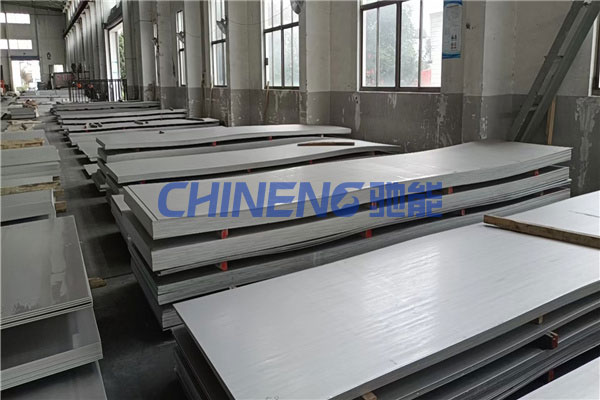
Thickness Tolerance Standards for Stainless Steel
Every stainless steel plate has some thickness tolerance; this cannot be eliminated at the physical level. To keep excessive variation from causing problems during fabrication, thickness tolerance standards were introduced. The two systems commonly seen on the market are national standards and industry standards.
National standard
The national thickness-tolerance standard (GB) is set by the state. Allowable ranges vary by industry. In commercial kitchen equipment, compliant manufacturers work to a national-standard tolerance of ±0.1 mm—meaning thickness variation across the sheet stays within ±0.1 mm. This is the primary standard used by CHINENG.
Industry standard
Industry standards are agreed among players in a given sector (or region, or mill) and therefore vary. For commercial kitchen equipment, typical industry-standard tolerance is about ±0.4 mm, and poorer material may be ±0.5 mm.
Most low-cost brands follow the industry standard. Thinner plate sharply reduces material and fabrication cost, but it also reduces reliability and service life.
Full-spec plate
Besides national and industry standards, you may also hear the term “full-spec” plate. Because of mill process variation, some sheets deviate more than others. Sheets that still stay reasonably close to the spec can be treated as meeting the national or industry standard. Full-spec plate is material that, after further inspection, fully meets the national or industry standard—usually with even tighter tolerance within that range.
If equipment quality is a top priority, full-spec national-standard stainless steel is an option, but equipment cost will be higher.

The above should clarify how industry and national standards differ for stainless steel thickness tolerance. When choosing commercial kitchen equipment or a kitchen-engineering contractor, we recommend established, reputable manufacturers. Commercial kitchen equipment is a production tool; durability and stability matter, and no operator wants machines that fail frequently.
If you need commercial kitchen equipment or a turnkey kitchen project, contact CHINENG. We will be glad to provide professional commercial kitchen services.
Prev: 没有了!
Price transparency
Nationwide coverage
Rapid design
Quick quote
Worry-free after sale
Guangdong Jiushang Electronic Technology Co., Ltd.
+86-400-0622-168
Mobile: +86-135-2862-7820
Contact: Manager Liu
Address: Building 5, Huyue Bay Area, Humen Town, Dongguan City, Guangdong Province, China